
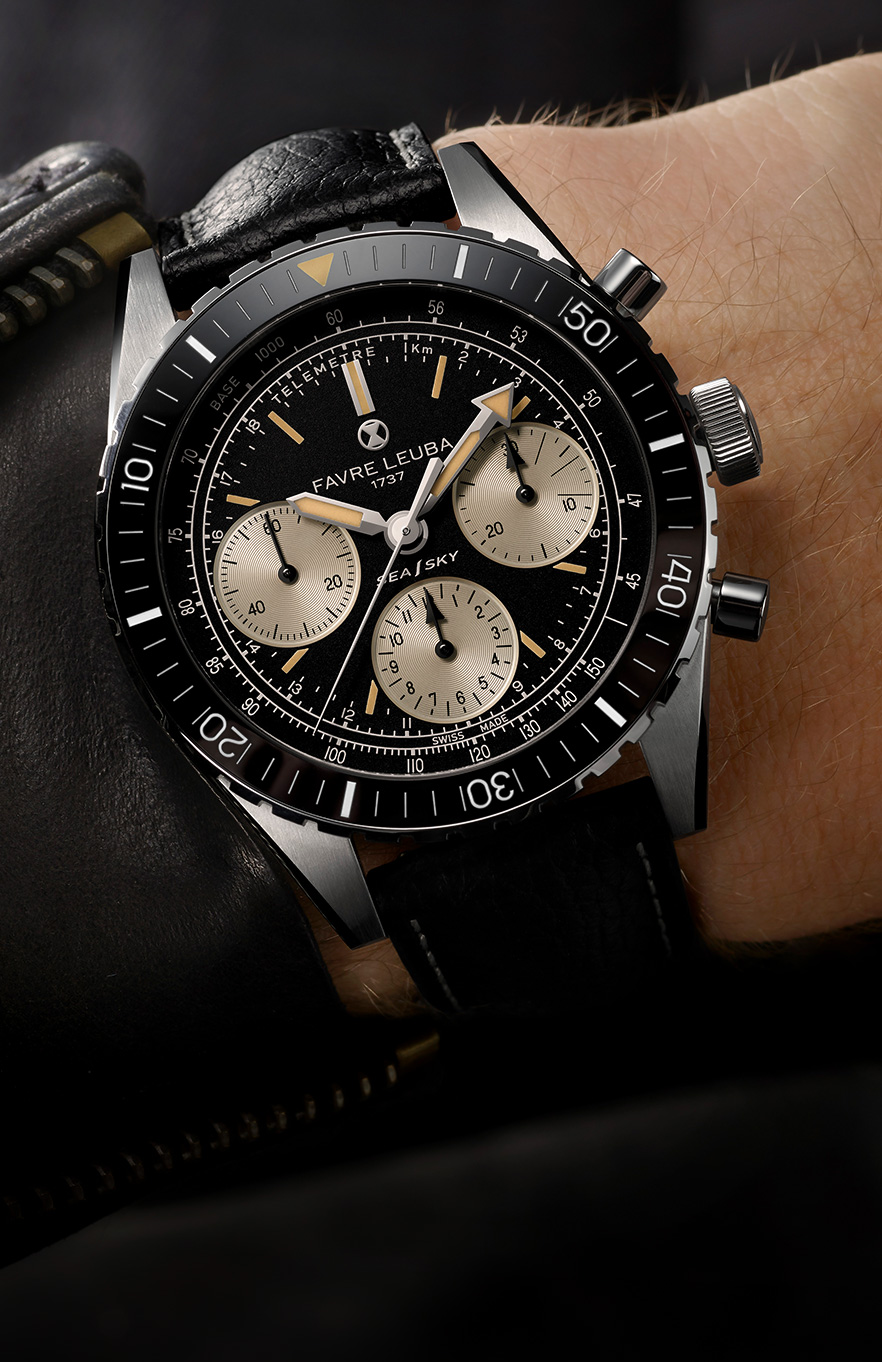
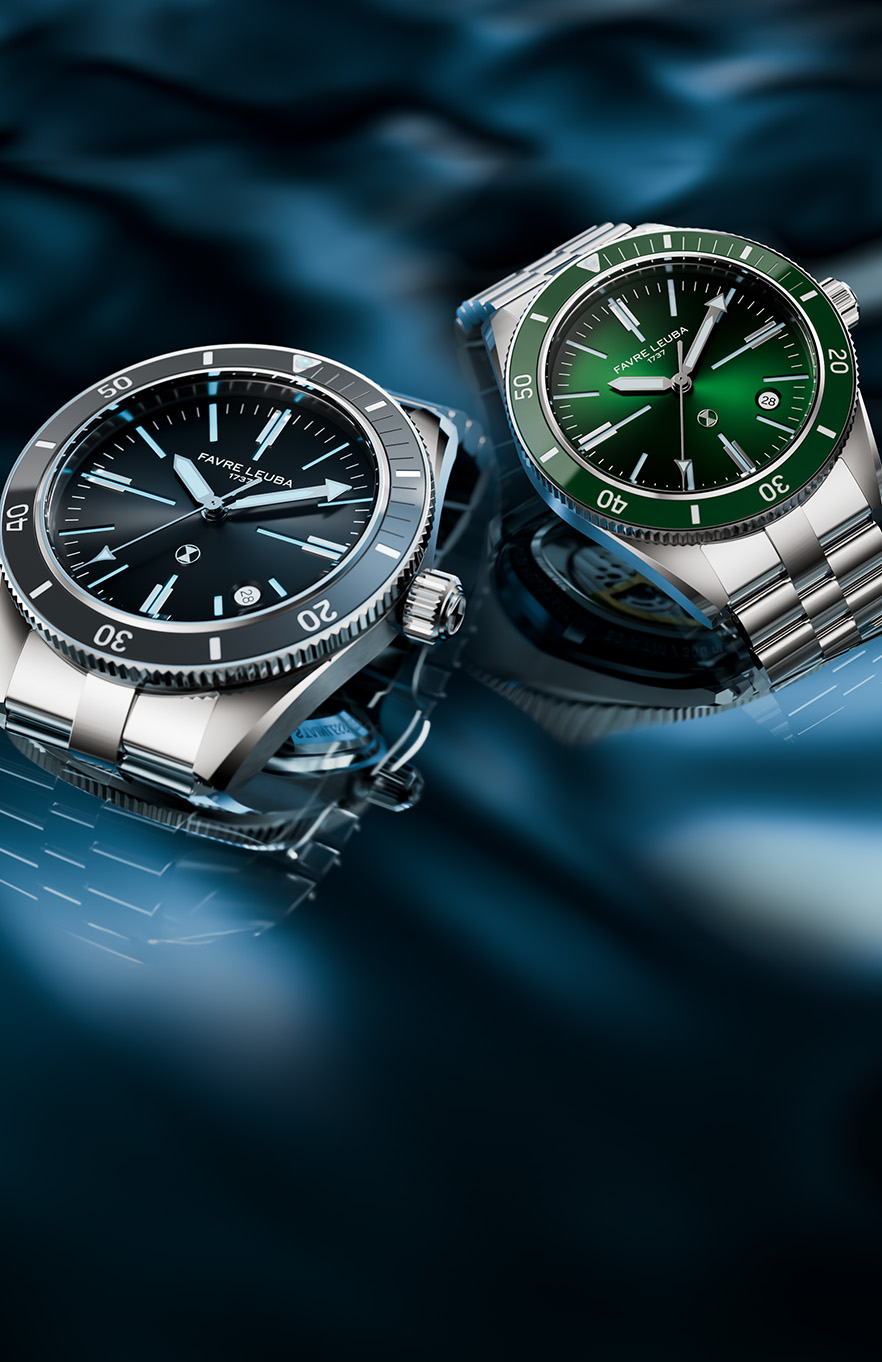


Favre Leuba’s collaboration with Jean Rousseau changes almost nothing about the Deep Raider Revival. The case is untouched, the movement is untouched, the dial is largely untouched. Three straps do the work instead—each one the starting point for a different interpretation of the same watch.

The two houses have come together for the first time on the Deep Raider Revival, creating three limited editions that retain the essential character of the dive watch while introducing a new visual language through materials, colours and finishing. Each version is limited to 33 pieces, making 99 watches in total.
A Deep Raider With Its Roots Intact
The Deep Raider Revival already has an important place in Favre Leuba’s recent history. Introduced alongside the brand’s 2024 relaunch, the watch looked back to the 1964 Deep Blue, a model that established Favre Leuba’s credentials in professional diving watches. The revival marked 60 years since that original watch, retaining its compact 39mm case and 300m water resistance while bringing the construction into the present. For the new collaboration, Favre Leuba has deliberately left that foundation largely untouched.

The 39mm stainless-steel case measures 48mm from lug to lug and 12.75mm thick. A boxed sapphire crystal sits above the grey sunray dial, while the unidirectional bezel uses a sapphire insert with a luminous triangle. The dial retains the Old Radium Super-LumiNova X1 treatment, giving the watch its characteristic green glow.
The mechanical side follows the same approach. The FLD01 automatic movement, based on La Joux-Perret’s G100, runs at 4Hz and provides approximately 68 hours of power reserve.
Three Straps, Three Interpretations
Jean Rousseau has created three handcrafted straps, and each material becomes the starting point for a different interpretation of the Deep Raider Revival. The black calf-leather version stays closest to the traditional language of a dive watch. Its soja grain finish is accompanied by beige stitching and a wave motif, while the caseback carries a hide-shaped symbol identifying the material. The black strap also determines the colour of the seconds hand and Favre Leuba monogram at 10:30.

The second version moves into sand-coloured technical fabric. Its slightly darker brown hand-stitching gives the watch a less conventional appearance, while a planet symbol on the caseback represents the material’s sustainability credentials. Here too, the colour of the strap is carried across to the seconds hand and dial logo.
The third interpretation uses beige rubber. It is the most contemporary of the three, and Favre Leuba extends that material reference to the caseback with a wheel motif. The seconds hand and monogram follow the same beige tone.
Details That Connect the Two Houses
Each caseback carries both Favre Leuba and Jean Rousseau branding, together with a symbol identifying the strap material. The underside of each strap is signed ‘JR for Favre Leuba 1737’, while the folding clasp carries the signatures of both houses.

It is a relatively restrained approach to a collaboration. Rather than adding decorative elements to an established dive-watch design, Favre Leuba and Jean Rousseau have used the strap as the point from which the rest of the watch is interpreted.